Hernia Treatment in Vizag
Hernia Treatment in Vizag | Vizag Surgicare
Do you experience a bulge in your abdomen or groin that becomes more noticeable when you cough or strain?
Do you suffer from:
- Discomfort or persistent pain in the abdomen or groin?
- A visible lump that disappears when you lie down?
Then it is an alarm to wake up and realise – you may be suffering from hernia. Explore the article to learn more and take proactive steps in managing hernias effectively.
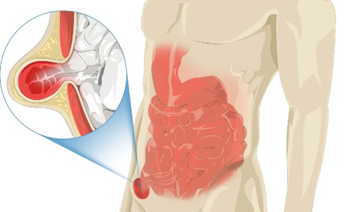
Hernia occurs when an internal organ or tissue bulges out through a weak spot in the surrounding muscle or connective tissue
Risk Factors:
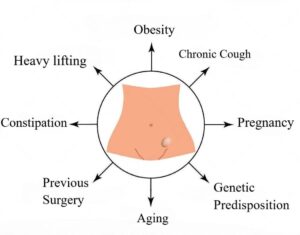
Following are the most common risk factors for the development of hernia –
Symptoms:
Hernias can present with a wide range of symptoms depending upon location, content of sac and severity of the condition. Most usual presentation being:
- Visible bulge – more pronounced on straining
- Pain or Discomfort – can be mild to severe
- Irreducibility – initially reducible on lying down
- Constipation
In severe cases, when the contents become irreducible and the blood supply hampers they may present in emergency with:
- Nausea & Vomiting
- Fever
- Obstipation – not able to pass gas
- Features of sepsis
Types of Hernia:
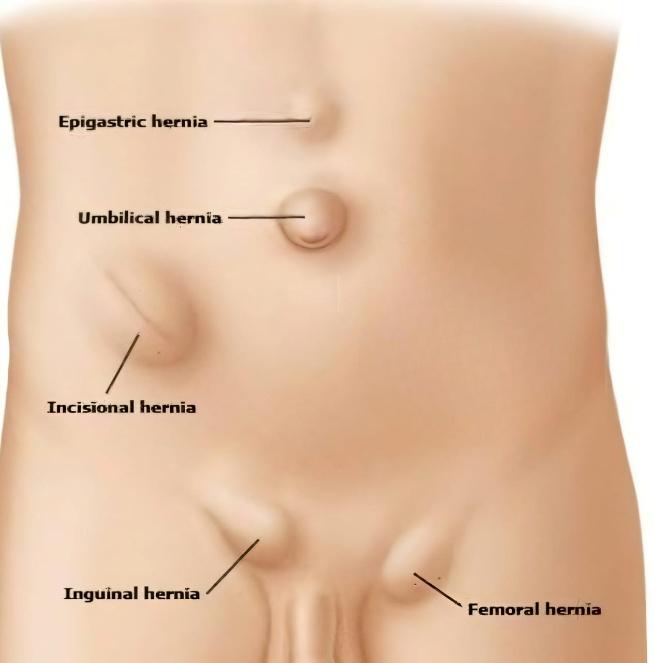
- Inguinal Hernia – Most common type among both men and women. It occurs in the groin region when intestines and omentum push through the inguinal canal or abdominal wall.
- Umbilical Hernia – Occurs near the belly button, when a part of the intestine pokes out due to raised intraabdominal pressure through a weak spot in the abdominal wall.
- Epigastric Hernia – These hernias are usually small in size, occurs when fatty tissue pushes through weak area in upper abdomen between breastbone (sternum) and belly button.
- Incisional Hernia – Incisional hernia develops when tissue protrudes at previously operated site due to weakened muscles.
- Femoral Hernia – A femoral hernia is less common type of hernia that occurs in femoral canal which presents as swelling in upper thigh or groin. It is more common in female due to wider pelvis. It has higher risk of complications due to small space and requires urgent surgical treatment.
There are other types of hernias which are rare in their presentations like Diaphragmatic hernia, Congenital hernia, Lumbar hernia, Spigelian hernia, etc.
Need Help?
We’re Just a Call Away!
When is Hernia Surgery Needed?
Surgery is the only option for most of the hernias. However, we can have a wait-and-watch approach for a few hernias like Small umbilical hernia/ Congenital umbilical hernia (hernia present at birth) which was detected incidentally with no symptoms.
Planning for surgery whether to post case electively or to post immediately depends on the presentation of the patient i.e., whether the patient presented with mild symptoms or presented with complications in a life-threatening condition. Early surgical intervention prevents complications and ensures faster recovery. Different surgical options are available based on type of hernia and severity.
Surgical Approaches:
- Herniotomy – Surgical procedure where the contents of the hernial sac are pushed back into their place and excess sac is removed. No mesh is placed in such a procedure. It is commonly done in children.
- Herniorrhaphy – Herniorrhaphy is a combination of Herniotomy along with anatomical repair of wall. Preferred technique in patients where synthetic mesh placement is contraindicated like in strangulated hernia (blood supply of the hernial content is cut-off)
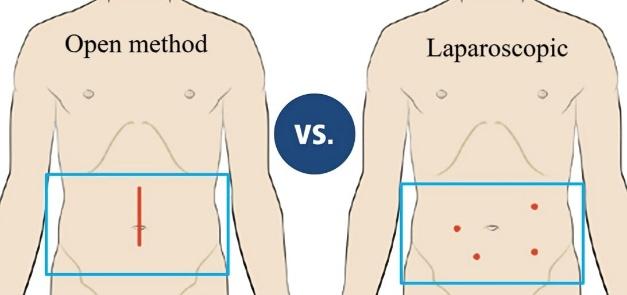
- Hernioplasty – It is a technique involving the repair of hernia with reinforcement of the wall with placement of a synthetic mesh. This is the most preferred surgical repair these days which can be done in open method or laparoscopic (Key hole surgery).
FACTOR | LAPAROSCOPIC REPAIR | OPEN REPAIR |
|---|---|---|
Approach | Small incisions with a camera (laparoscope) and instruments | Single large incision over the hernia site |
Anaesthesia | General anaesthesia required | Local, regional, or general anaesthesia |
Mesh Placement | Mesh placed inside the abdominal wall | Mesh placed over or under the muscle |
Pain & Recovery | Less post-op pain, faster recovery | Relatively more post-op pain, longer recovery |
Scarring | Minimal scarring due to small incisions | Larger scar at the incision site |
Complications | Risk of organ injury, but lower infection rate | Infection risk comparatively higher |
Suitability | Preferred for bilateral or recurrent hernias | Preferred for large, irreducible or recurrent hernias |
FACTOR | LAPAROSCOPIC REPAIR | OPEN REPAIR |
|---|---|---|
Approach | Small incisions with a camera (laparoscope) and instruments | Single large incision over the hernia site |
Anaesthesia | General anaesthesia required | Local, regional, or general anaesthesia |
Mesh Placement | Mesh placed inside the abdominal wall | Mesh placed over or under the muscle |
Pain & Recovery | Less post-op pain, faster recovery | Relatively more post-op pain, longer recovery |
Scarring | Minimal scarring due to small incisions | Larger scar at the incision site |
Complications | Risk of organ injury, but lower infection rate | Infection risk comparatively higher |
Suitability | Preferred for bilateral or recurrent hernias | Preferred for large, irreducible or recurrent hernias |
Post Surgical Care and Recovery:
Post operative care includes pain management and lifestyle modifications to promote healthy healing and recovery.
- Medications : Antibiotics, analgesics as advised
- Wound Care : Keeping the surgical area clean and dry. Change the dressing alternate day or as advised by your healthcare professional. Regularly check the surgical site for any signs of infection like increased pain, swelling, redness or discharge
- Supportive Garments : Apply abdominal binder as advised by your care provider. It gives support to the operated area and reduces discomfort
- Rest : No need of complete bed rest. Walking is encouraged to reduce complications. Any strenuous exercises and lifting heavy weights should be avoided for 4-6 weeks, to promote healing and reducing chances of recurrence. Maintain optimal BMI (18.5 to 23.0)
- Diet and Hydration : Protein rich diet is advised for better healing. Fiber and plenty of liquids should be encouraged to reduce chances of recurrence as they help in reducing
- Avoid Smoking and Drinking Alcohol: Interfere with healing process and increases chances of infection and recurrence
Conclusion:
Feel free to come and visit our clinic – “VIZAG SURGICARE” in case of any pain or persistent bulge in your body. We ensure a comprehensive approach in treating hernia which best suits your presentation combining expertised skills and personalised post operative care to guide you for healthy and faster recovery.
contact us
Get In Touch With Us
phone number
Mobile No 1 : +91-77029 50513
Mobile No 2 : +91-9848638615
Mobile No 3 : +91-9849239213
our address
First Floor, Mohan Medical Shop, Seethammadhara (NE), Visakhapatnam-530013
email address
info@vizagsurgicare.com